
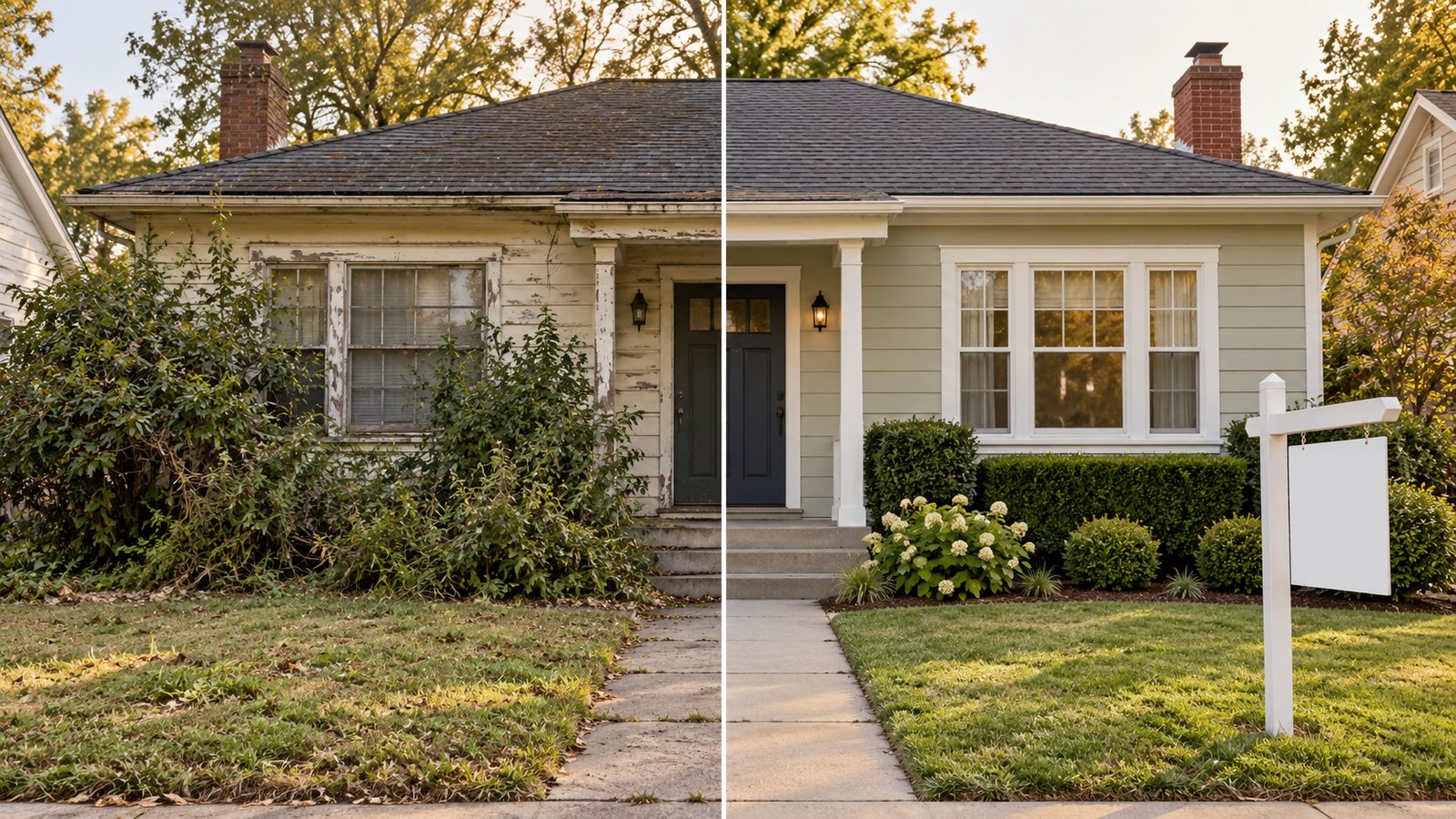
Neither path wins every time. A cash offer buys speed, certainty and an as-is finish, and it costs price. A listing usually puts more money in the estate when the house is financeable and the estate can carry it. The answer comes from the net dollars, not the headline number.
Two things get confused constantly. A cash sale does not avoid probate, so if the court must confirm the sale it confirms the cash sale too. And a cash buyer’s number is net, while a list price is gross, with commission and repairs still to come out.
Key Facts
- A cash sale does not skip probate. Court confirmation, where required, applies however the buyer pays. Probate Code 10308
- A court cannot confirm a private sale below 90% of the appraised value, appraised within one year before the hearing. Probate Code 10309
- Full IAEA authority removes the 90% minimum and the overbid. Probate Code 10503
- The standard California fire policy suspends coverage past 60 days of vacancy. Insurance Code 2071
What Is a Cash Offer Actually Buying?
Speed, certainty, an as-is condition, and an end to the holding costs. No appraisal contingency, no loan underwriting, no repair requests. A buyer taking all of the condition and resale risk prices it in, and that price is your discount.
When Is a Cash Offer the Right Call?
The house has defects a lender will not finance. Severe foundation movement, a failed septic or sewer, fire damage, an uninhabitable interior. A financed buyer cannot close, so the real market is already a cash market.
The estate has no money. Mortgage payments, taxes, insurance and utilities do not stop. If the estate cannot carry the house, a faster close can beat a higher gross price.
The house is vacant and exposed. Coverage can be suspended past 60 days of vacancy under Insurance Code 2071, and one uninsured loss erases any price advantage. See vacant inherited houses.
The family wants it finished. Sometimes the right answer is the one that ends soonest.
When Does a Listing Net More?
When the house is financeable and the estate can carry it. On a standard ranch or tract home in reasonable condition, the open market reaches far more buyers than any single cash buyer, and competition sets a higher price than a discount formula. It also reaches owner-occupant buyers, who tend to pay the most.
Can the Court Confirm a Discounted Cash Offer?
Not if the sale needs confirmation and the discount runs too deep. A private sale cannot be confirmed unless the offer is at least 90% of an appraisal from the prior year, under Probate Code 10309. An offer at 85% cannot be confirmed, and even one above 90% can be overbid at the hearing, starting at 10% of the first $10,000 plus 5% of the rest, under Probate Code 10311.
Under full IAEA authority there is no 90% floor and no overbid, so the discount is possible. The representative still owes duties to the heirs, and a Notice of Proposed Action lets them object. See the probate sale process.
What Does This Look Like With Real Numbers?
Illustrative example, not a real client. Costs and commission rates vary and are negotiable. In a court-confirmed sale the court sets the commission under Probate Code 10160 and 10161.
A house appraises at $500,000 and would sell on the open market for about that.
Option A, the cash offer. $425,000, as-is, no repairs, no commission, closing in 14 days. Closing costs at 1% are $4,250, so the estate nets $420,750.
Option B, the listing. Sale price $500,000, preparation $12,000, commission at 5% of $25,000, closing costs at 1% of $5,000, and three more months of holding costs at $1,100 a month, or $3,300.
- $500,000 minus $12,000 is $488,000, minus $25,000 is $463,000
- minus $5,000 is $458,000, minus $3,300 is $454,700
The listing nets $454,700 against $420,750, a difference of $33,950. The cash offer is also 85% of the appraisal, so a court could not confirm it where confirmation is required.
Now change one fact. The inspection finds a failed sewer lateral and foundation movement, and the realistic price drops to $440,000, with the same $12,000 of preparation and the same $3,300 of holding costs. Commission at 5% becomes $22,000 and closing costs at 1% become $4,400.
- $440,000 minus $12,000 is $428,000, minus $22,000 is $406,000
- minus $4,400 is $401,600, minus $3,300 is $398,300
Now the listing nets $398,300 against the cash offer’s $420,750. The cash buyer is ahead by $22,450 and the estate carries no repair risk. One condition problem flipped the answer.
What Should You Check Before Signing?
- Who the buyer is, and whether they will close or assign the contract.
- Proof of funds, dated, from a real institution.
- Whether the price can be renegotiated later.
- Whether the sale needs court confirmation, which decides if the 90% rule applies.
Summary
- A cash sale does not avoid probate, and no court confirms a private sale below 90% of a recent appraisal.
- Full IAEA authority removes the 90% floor and the overbid.
- In the example above, listing nets $454,700 against $420,750 for cash on a sound house, and the cash offer wins by $22,450 once the house has failed systems.
Next Steps
Talk with Bart: Book a free 15-minute call. I’ll listen to where you are in the process, look at the property, and tell you your options, including the ones that don’t involve hiring me.
Request a free probate home valuation: You’ll get a written price range within one business day, to hold any cash offer against.
Related Reading
- Sell an inherited home in the Sacramento area
- How a probate home sale works
- Preparing a probate home
- Cash buyer or listing: which is better for a probate house?
- Should you fix up an inherited house or sell it as-is?
About the Author
Bart Hubbard is a Realtor with HomeSmart ICARE Realty (DRE #01815497) and a C.A.R. Certified Probate and Trust Specialist who helps families across the greater Sacramento area sell inherited, probate and trust homes. He works alongside probate attorneys, fiduciaries and local vendors to handle pricing, cleanouts, repairs and court-confirmation sales, so executors can focus on their families. More about Bart is on his bio page.
This page is general information, not legal or tax advice. Probate and tax rules depend on your facts. Talk with a California probate attorney or CPA before acting. Figures current as of October 2026.